
Choose your mountain
Pick a peak, an interval program, and how long you have — 20, 30, 45 or 60 minutes. The program decides which zones you'll be asked to hold and when.

Raise your heart rate to climb. Settle it to descend. Hold the target zone and you score — drift out and the mountain stops moving. Eleven real interval programs, five peaks, and a Summit Card at the end of every one.
Free to play. $3.99 once unlocks every mountain and program. No subscription, ever.
The only gear you need is an Apple Watch and a willingness to work for it.
Pick a peak, an interval program, and how long you have — 20, 30, 45 or 60 minutes. The program decides which zones you'll be asked to hold and when.
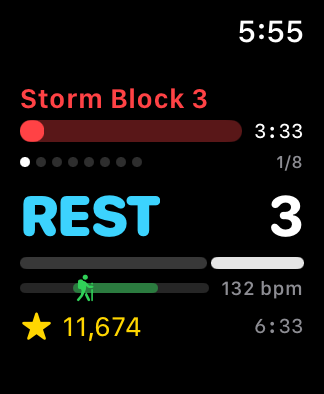
Your Watch reads your heart rate every few seconds. A hiker rides a band on screen: inside the band you're climbing and scoring, outside it you've stalled. That's the whole game.
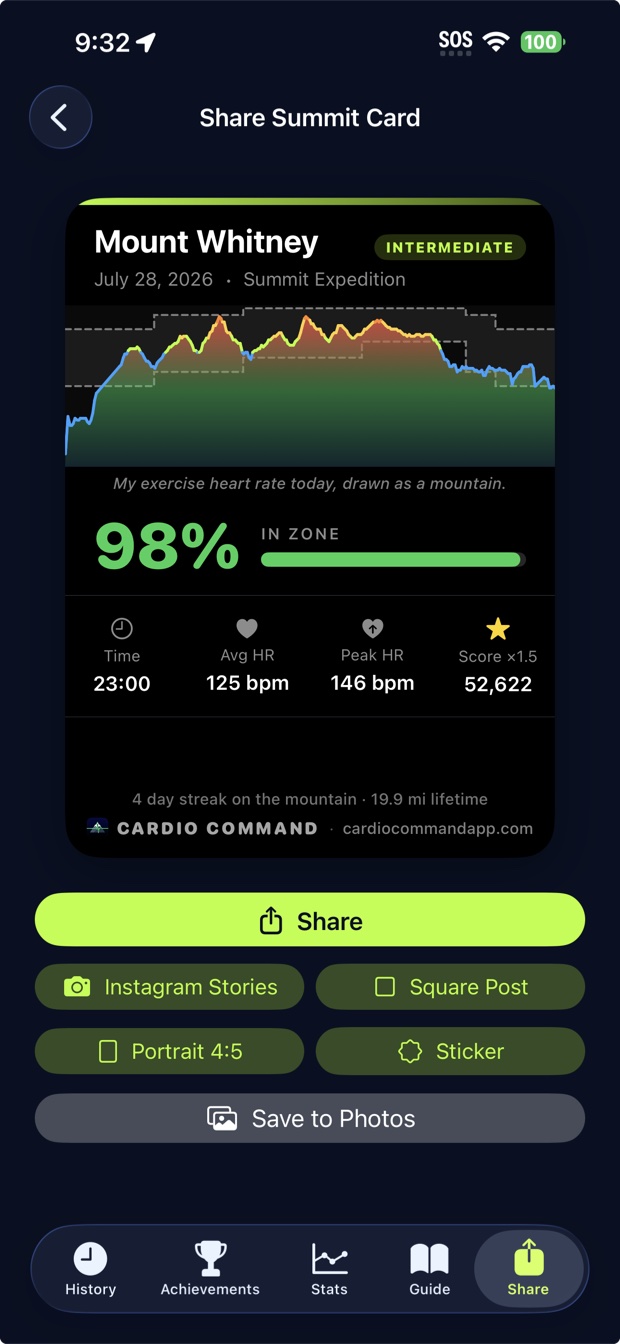
Every climb draws your heart rate as a mountain silhouette — a card no two climbs share. Share it from your wrist the moment you finish.
A ring is a scoreboard you read afterwards. It doesn't ask anything of you while you're actually on the treadmill, and it never once tells you that right now you're 4 bpm too low.
Most fitness apps grade you when it's over. Cardio Command scores you every second you're inside the band — so the interval you were going to coast through becomes the interval you're trying to nail.
The result is a workout you can actually lose — which turns out to be the thing that makes people finish it properly.

Two things multiply your score, and they stack. How long you've held the band without a break, and how close to dead centre you're holding it.
The score multiplier maxes out at ×3 after a minute. Past that the flame keeps climbing anyway — it brightens, the band thickens behind it, and at five, ten, twenty and thirty minutes it stops being a glyph and announces the milestone out loud.
Being inside the band scores. Being within 3 bpm of dead centre scores 20% more, and the display switches from IN ZONE to PERFECT to tell you. It's the difference between completing a program and actually perfecting it — and it compounds with the streak multiplier rather than replacing it.
Cardio Command tells you where you are without asking you to raise your arm — a cue vocabulary for entering the zone, drifting out, a zone change coming in fifteen seconds, a summit, a streak milestone. Paired with haptics, so it works with headphones or without.
Tones and haptics, nothing underneath. The default, and the quietest option that still coaches you.
Play whatever you already listen to. Cues duck the music briefly and let it back up — the same way turn-by-turn navigation does. Transport controls are one swipe away mid-climb.
Original instrumental beds written for climbing, matched to the shape of your program.
Cue volume is separately set to Full, Minimal, or Silent — the music setting and the cue setting don't fight each other.
Every program is a real protocol with a mountain on top. The depth is the point — this isn't one workout with a skin on it.
Grouse Mountain, Mount Whitney, Kilimanjaro, K2, Everest. Target bands narrow and warning windows shorten as you go up — Everest gives you a five-bpm band and five seconds' notice.
Norwegian 4×4, Tabata, 10-20-30, Pyramid, Tempo, Zone 2, 30/30, Fartlek, Rescue Mission, Storm Shelter, and the classic progressive ascent. Real protocols, not invented ones.
Rockfall narrows your band mid-interval. Altitude Sickness drops it. Whiteout hides your heart rate entirely and asks you to navigate by feel. Thirty seconds each, forty-five for Rockfall — and they change everything.
Your heart rate over the whole climb, drawn as a mountain skyline against the zones you were asked to hold. Personal records get a ribbon. No two are alike.
Five tracks — Summit, Precision, Event, Dedication, Collector. Some reward volume; the good ones reward a single climb done exactly right, and a few are calendar-locked to one day a year.
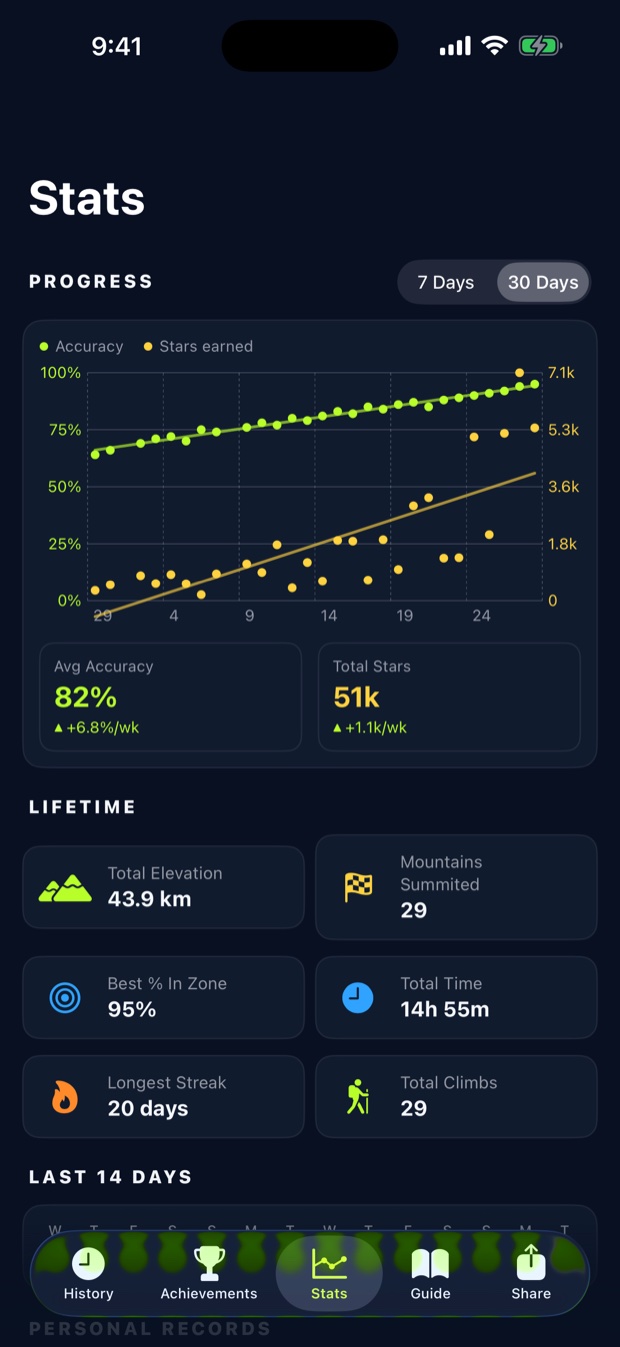
Every climb syncs over iCloud. Full history, the badge grid, 7- and 30-day accuracy trends, personal records per mountain, and high-resolution card exports. Included free.
Nobody screenshots a closed ring. The Summit Card exists because the thing that actually keeps people training is other people noticing — and because your heart rate, drawn as a mountain range, is genuinely nice to look at.
Because the score is built on precision rather than effort, improving is legible: the same program on the same peak, held tighter than last time, is a visibly better climb. The phone app plots accuracy over 7 and 30 days so you can see the line move.
Each peak is harder than the last — tighter bands, shorter warnings, less margin. Difficulty is also worth more: a climb on Everest scores five times what the same precision earns on Grouse.
Wide bands, long warnings. Where you learn to read the game. Free.
Bands tighten. The first peak where drifting actually costs you.
Long sustained efforts with less tolerance. Discipline over bursts.
Fast transitions, tight bands, eight seconds of warning before the ground shifts.
A five-bpm band and five seconds' notice. Every program available, nothing forgiven.
Storm Shelter runs the game in reverse. Start from whatever elevated heart rate you arrive with — post-run, post-argument, post-bad-day — and bring it down. The band narrows as you go, so settling becomes the skill being scored.
Not a subscription. Not a trial that expires. One purchase, tied to your Apple ID, forever.
The whole game, on one mountain.
Free means free. No ads, no timer, no nagging.
Everything above, plus the rest of the range.
Badges are never paywalled — you earn them on the free tier the same as anywhere else. The hardest ones just happen to live on peaks and programs Pro opens up.
Norwegian 4×4 for VO₂ max. Tabata for anaerobic capacity. Zone 2 for mitochondrial density. Every program is a published protocol — the game wraps it, the protocol does the work.